Customers, jobs, tasks, crew, money
Cross-linked, so a change in one place is a change everywhere. A measurement becomes an estimate becomes an invoice without anybody keying it in again.
Operating systems for contractors
We build your company its own operating system, shaped to how you already run — and we keep reshaping it as you grow. One place where the jobs, the crew, the money and the paperwork actually live.
Built first for roofing — the system is running today
Fifteen minutes, no email needed. You get a score out of 100 and the three things costing you the most. Not ready for that? See what the system actually is →
01 / The problem
Ask a contractor where a job lives and you get a tour. The measurement is in one app, the photos on somebody’s phone, the schedule in a text thread, and the invoice in QuickBooks, which never saw the job — only the bill. Nobody chose that. It accumulated.
So somebody re-types it into the next one, and now there are two versions of the truth and nobody can say which the crew is working from.
Which is why buying another tool rarely helps. It gives you a fifth place for a job to live.
The details that matter are in your head, and there is no version of them anyone else can read. The honest test is not whether you could take a week off. It is whether you could hire somebody next month and have them be useful — because if everything worth knowing lives in one person, there is nothing to hand them.
Consultants show up, produce a document, and leave. Nobody is there on the Tuesday it actually breaks, or the month you add a service line and the whole shape of the work changes.
Seven figures a year and you still cannot leave for a week without the whole thing bending around your absence. Money that was earned and never billed, pricing set by instinct because job profit arrives weeks late — those cost you too, but this is the one you feel on a Sunday.
02 / The solution
Every system in this category says all-in-one, and every one of them means all-in-one for a thousand roofing companies at once. This one is built for yours: the job, the customer, the crew, the money and the paperwork as the same records, in your language, on your domain, and it belongs to your company.
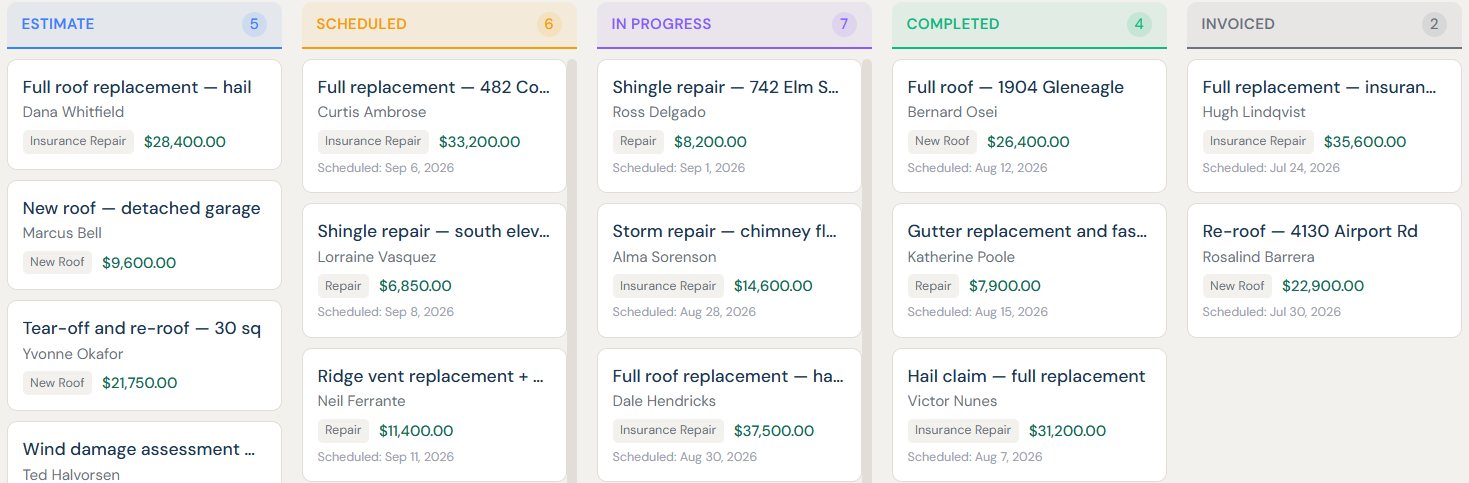
Pontura Roofing OS — the job pipeline.
Cross-linked, so a change in one place is a change everywhere. A measurement becomes an estimate becomes an invoice without anybody keying it in again.
For roofing that means insurance claims, adjuster estimates and supplement comparisons. For yours it means whatever you are re-typing today.
On your own domain, with multi-factor sign-in, exportable in a format you can use — and yours on the day you leave as much as the day you start.
The office sees the money. The crew sees the work. Everybody opens it and finds their own job waiting.
If the thing you need is not on this list, that is where the conversation starts. You are not being handed a fixed product to take or leave. Tell us what your company actually needs, and we will build it if we can and say so plainly if we cannot.
The name is the argument. Pontura, from ponte — Portuguese for bridge. The gap is between the software you can buy and the company you actually run, and right now you are paying somebody’s wage to stand in it. This is the bridge that does not need a wage.
03 / Who it is for
Somewhere past a few million in revenue, the way you have always run things stops scaling. The work is there, the crews are there, there are people in the office now — and a spreadsheet, a shared inbox and two people who remember everything have quietly become the thing holding it back.
The system is built for that company. Not the one-truck operation, which does not need it yet and should not be paying for it. Not the hundred-person regional, which already has an ops department and a five-year contract with somebody. The company in between, where the revenue is real, the headcount is real, and the process is still living in somebody’s head.
Roofing is built. HVAC, plumbing and general contracting are not. The base covers what every contracting business does; the fitting covers what only yours does.
04 / What it costs
Almost nobody in this category will tell you what their software costs without putting you through a sales call first. We will, and here it is.
Builds start at $6,500, most land around $9,500, and complex ones run $15,000 and up, quoted on the size and shape of your company. After that a monthly plan, from $250, flat at every level — putting your whole crew in it does not move the price.
The plan buys build capacity rather than seats: the higher levels include a stated number of changes a month, and the pricing page says in plain words what counts as a small, a medium and a large one.
You will know the number before the call.
05 / How we stay
A system built once and left alone is a document. Your business changes — new crew, new service line, a rule that did not exist last year — and the system changes with it or it becomes another thing nobody opens.
So we do not hand it over and disappear. Every build comes with a standing call: what you need gets scoped and sized there, and what your plan covers goes out in the next release. No ticket, and no roadmap other customers vote on. It runs for as long as you want us, and the day you are done the data is yours and the system keeps running.
No sales team, no ticket queue, no roadmap vote you lose to a company ten times your size. When something breaks you are speaking to the person who wrote it.
Nothing here has been sold to a hundred contractors yet. What that buys you is more of my attention than an established vendor would give you, and less proof than one could show you. Both are real.
Twenty-five questions, about fifteen minutes, scored on screen. Then decide whether a conversation is worth sixty more.
The evaluation is the first step for most people, and it costs you nothing but the fifteen minutes. Book the call instead if you already know you want to talk.