Pontura
Book a call Score your operationScore yours
Menu

What we build

One system, and it belongs to your company.

The place a job lives, from the first call through to the final invoice.

We are not consultants. Nobody is going to hand you a process document, a slide deck, or a recommendation to run leaner. We write software.

What that buys you is the removal of the handoffs — the moments where a job leaves one tool and has to be carried into the next one by a person who might be busy, or off that week, or new.

Why not the big roofing software? Because it works, and that is not the question. AccuLynx has been at this since 2008 and will beat us on the length of the feature list for as long as it exists. What it cannot do is be built for your company — not because the people there are worse at this, but because a thousand roofers share one codebase, and a change for one of them is a change for all of them. That is a fact about the business model, not a failing.

Why not a consultant? A consultant produces a document and then leaves. The document is often right. But the thing that actually breaks is a Tuesday in March — a new service line, a rule that did not exist last year, a report somebody now needs weekly — and on that Tuesday the document cannot be changed and the consultant is at another company. What you need on that Tuesday is somebody who can edit the software.
01  /  The system

What is actually in it

Six things, and the point is not that any one of them is clever. The point is that they are the same system, so nothing has to be typed in twice and nothing sits in the gap between two tools where nobody owns it.

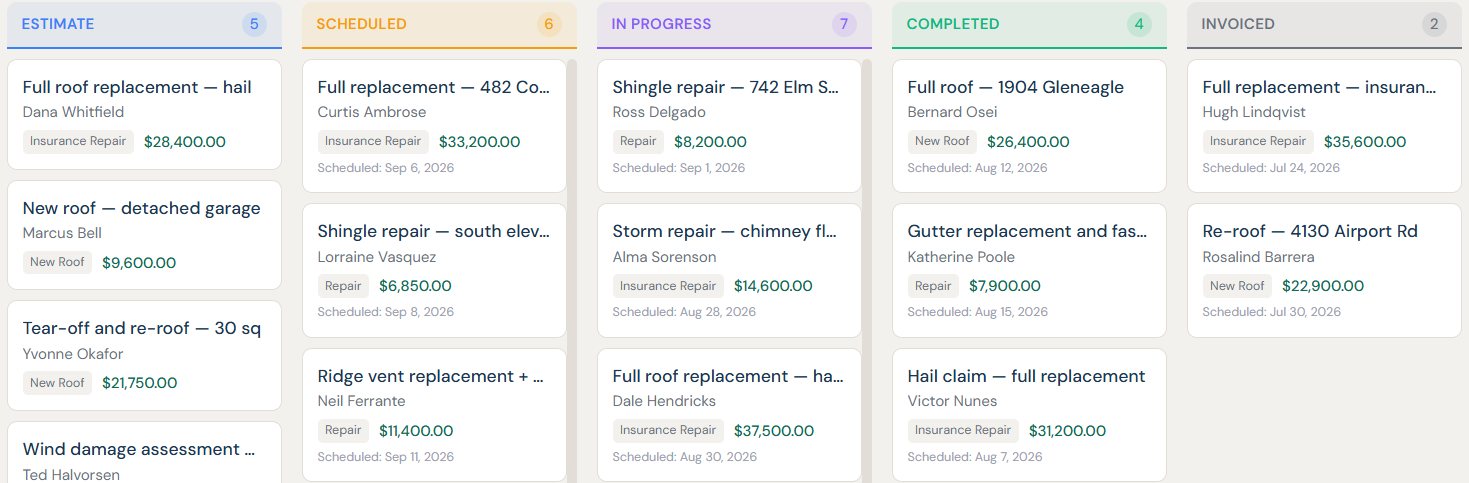
Estimate → Scheduled → In progress → Completed → Invoiced The job pipeline
The job pipeline board in Pontura Roofing OS, with jobs in five columns: estimate, scheduled, in progress, completed and invoiced. Each card shows the customer, the job type and the value.

Pontura Roofing OS — the job pipeline.

Jobs

One place a job lives

From the first call through to the final invoice, in the stages your company already uses. Squares, pitch, stories, layers to tear off and gutter feet sit on the job itself, with the measurement report attached, so the estimate is built from the roof, not from memory.

Customers

The whole history

Every job, every conversation, every document sits against the customer it belongs to, in one record you can open while they are still on the phone.

Claims

Not dependent on who is on

RCV, ACV and both kinds of depreciation on the claim, with the adjuster, the ladder-assist firm and the mortgage company on the same record. The carrier estimate sits next to yours, so the gap you are filing a supplement over is a number on the screen rather than something somebody has to notice.

Photos

Filed, not texted

Shot on the roof and attached to the job on the way past, so they are there when the adjuster asks, instead of on somebody's camera roll.

Invoicing

Billed from the job it came from

The invoice is raised from the job it came from, so what was costed, what was billed and what came in all sit against the same record — instead of being re-keyed into an accounts package that never saw the job.

Your numbers

Job profit while it matters

What a job actually made, close enough to the job that it can still change how you price the next one. Set a minimum margin and the system tells you which jobs fell under it, while there is still something to do about it.

02  /  The difference

Built for one company, not for the average of everybody

The software you can buy off the shelf was built for a thousand roofing companies at once, which means it was built for the average of them. Every one of those thousand has to bend a little to fit it. The bending is invisible until you count the workarounds.

A system built for one company does not need a workaround, because there is nothing to work around.

For the same reason, a feature you need goes straight onto the standing call. There is your system, and the changes you want made to it.

How the work actually runs →
What it costs →

03  /  Before you commit

Three things to ask us about on the call.

These come up on nearly every call, and the answers are the ones a vendor would rather you found out later. Here they are first.

01

QuickBooks

The financial side runs today: invoices raised from the job they came from, payments tracked against them, receivables aged into buckets, and cost and margin on every job. What is unfinished is the two-way sync. The connection to QuickBooks is built and it has not yet been proved in a live company’s books. We will show you exactly what it does on screen rather than let you assume it does more — and if the sync is the part you are buying, ask us for a date before you commit to anything.

02

Your crews’ phones

The direction is a system you sign into from any device, including a phone in a driveway, rather than something that only works at a desk in the office. It is not finished either. Ask on the call and you will get a straight answer about what works on a phone today.

03

Getting your data out of what you use now

AccuLynx, JobNimbus, CompanyCam — what each of them lets you export varies, and anybody who tells you they can move all of it before looking at your account is guessing. We look at what is actually exportable and tell you before you commit to anything, while it can still change your mind.

The features are the floor, not the ceiling.

Every list on this page is where your system starts. It is not where it stops, and that is the difference between this and anything you buy off a shelf: a shelf product's feature list is a ceiling, because what gets built next is decided by a thousand other companies.

So you can turn modules off, and your people see the parts they actually use and nothing else. And if the thing you need is not on any list here, that is the start of a conversation rather than the end of one — we will build it if we can, and say so plainly if we cannot.

Start with where you actually stand

Fifteen minutes, scored, results on screen immediately. It is the fastest way to find out whether any of this applies to you.

If you are still working out whether any of this applies to your company, the evaluation answers that in fifteen minutes. If you already know it does, book the call.